
Thursday, August 03, 2006
writing systems and languages of the world
Try Omniglot for learning about writing systems from all over the world (and some from outer space, Fairie, etc.).


Wednesday, August 02, 2006
your library just got smarter
After thinking on worldcat.org for a bit, I'm really really excited:

This is like taking the best from post-Google web interfaces (simplicity of design, aesthetic appeal, and making web tools people-centered [“find books in a library near you”!]) and putting it to work for our libraries. This is big-boy Library 2.0 business, here. This is the sort of 2.0 that means so much business it actually brings virtual and real worlds closer together. This is the sort of 2.0 operation that'll hasten A.I. Hasten that viridian and silver future of truly ubiquitous and benevolent computation. This is the kind of move that's going to save libraries. I can't say enough, or I'll say too much. I'd better stop.
Excited, yes yes: this is me wearing rose-tinted augmented-reality specs.
This is like taking the best from post-Google web interfaces (simplicity of design, aesthetic appeal, and making web tools people-centered [“find books in a library near you”!]) and putting it to work for our libraries. This is big-boy Library 2.0 business, here. This is the sort of 2.0 that means so much business it actually brings virtual and real worlds closer together. This is the sort of 2.0 operation that'll hasten A.I. Hasten that viridian and silver future of truly ubiquitous and benevolent computation. This is the kind of move that's going to save libraries. I can't say enough, or I'll say too much. I'd better stop.
Excited, yes yes: this is me wearing rose-tinted augmented-reality specs.
11 info viz: internet of things / places / images
http://labs.live.com/photosynth/video.html
I don't know how to embed the video, but have a go on your own. Live Labs is doing something pretty darn cool. Their Photosynth project blends the 'real' and 'virtual' worlds through patching together all the photographs they can get from all the places they can get to.
If this works well, how long before we can put realia in place of images to create a networked library of 'things' that are both real and virtual at the same time? Would these be spimes? Is this a real, practical step towards kirkyans?

I don't know how to embed the video, but have a go on your own. Live Labs is doing something pretty darn cool. Their Photosynth project blends the 'real' and 'virtual' worlds through patching together all the photographs they can get from all the places they can get to.
If this works well, how long before we can put realia in place of images to create a networked library of 'things' that are both real and virtual at the same time? Would these be spimes? Is this a real, practical step towards kirkyans?
Tuesday, August 01, 2006
Monday, July 31, 2006
13 comics: Warren's free webcomics portal?
From Publishers Weekly / The Beat:
That could be good. The more I learn about Webcomics, the more interested I am -- and it will be nice to have a bunch of them curated for me by a writer I like, so I don't have to sort through lots of junk for days before finding the good stuff. Read Scott McCloud's thinking on the "infinite canvas" if you haven't already...

Warren Ellis to Launch Free Webcomics Portal
Warren Ellis is putting his money where his mouth is with his interets in webcomics, according to a post by Joey Manley at Comixpedia:
I am working with Warren Ellis to launch a free webcomics portal using the new Webcomics Nation Collective Edition Engine. This latest addition to the Modern Tales family will be all free, all the time, and defined by ‘Warren Likes This Stuff.’ He’ll be making a call for submissions soon. Gary Chaloner will be designing the site. This is the first new (as opposed to pre-existing) site to launch with the beta version of the WCN Collective Edition engine, soon to be a commercial product available to anybody who wants to launch a multi-creator webcomics portal (your own Keenspot or Modern Tales, in other words) inexpensively and with ease. The name of Warren’s new site, and its URL, will be announced soon, probably at The Engine.--
That could be good. The more I learn about Webcomics, the more interested I am -- and it will be nice to have a bunch of them curated for me by a writer I like, so I don't have to sort through lots of junk for days before finding the good stuff. Read Scott McCloud's thinking on the "infinite canvas" if you haven't already...
how to stay cool without an air conditioner
The AC went bust Saturday afternoon, Texas, July. Hot weather.
Here's some steps we took to stay cool in the rising heat.
1. Turn on the fans. Circulating air makes you feel cooler than you really are. Plus, you can use the push and pull of fans in different parts of the house to move warmer air out of the room you're in.
2. Get naked. Why insulate?
3. Create heat sinks. Fill a tub with water, dump ice in it. If you can, do this in spare bathroom and kitchen sinks too. This pulls heat out of adjacent surfaces and air. Empty the tub or sink when water gets warm. Repeat.
4. Make a make-shift air conditioner. I froze water in a big plastic mixing bowl, then propped a box fan up in front of it on a towel. The fan pulls air across the ice, then blows the slightly cooler air out across your room. Have another bowl freezing so that you can switch them out when the first melts.
5. Keep it dark. I taped sheets of white paper on our windows to reflect the sunlight (aluminum foil would have worked better, I think), then closed the blinds. Light = more heat!
6. Don't move around much. Lay still and drink something cool while you read or watch Deadwood.
7. Don't open your doors much. If you need to go outside, coordinate it with others in your house so you can all go out and come in together, thereby reducing the amount of time the door is open and the amount of warm air that comes in.
8. Use ice if you've got ice, and make as much ice as you can. You're freezer will become your only source of cold when your AC is out!
--
Note: I thought it would be a good idea to fill plastic bags with water -- the kind you get in the produce department for your veggies -- and pop them in the freezer to make more ice. This ain't a good idea. When the water crystalizes, it can pierce the thin plastic and the unfrozen water'll leak all over your freezer.
--
Watching: The World's Fastest Indian
Listening: 16 Horsepower
Weather: Yeah. Weather.
Here's some steps we took to stay cool in the rising heat.
1. Turn on the fans. Circulating air makes you feel cooler than you really are. Plus, you can use the push and pull of fans in different parts of the house to move warmer air out of the room you're in.
2. Get naked. Why insulate?
3. Create heat sinks. Fill a tub with water, dump ice in it. If you can, do this in spare bathroom and kitchen sinks too. This pulls heat out of adjacent surfaces and air. Empty the tub or sink when water gets warm. Repeat.
4. Make a make-shift air conditioner. I froze water in a big plastic mixing bowl, then propped a box fan up in front of it on a towel. The fan pulls air across the ice, then blows the slightly cooler air out across your room. Have another bowl freezing so that you can switch them out when the first melts.
5. Keep it dark. I taped sheets of white paper on our windows to reflect the sunlight (aluminum foil would have worked better, I think), then closed the blinds. Light = more heat!
6. Don't move around much. Lay still and drink something cool while you read or watch Deadwood.
7. Don't open your doors much. If you need to go outside, coordinate it with others in your house so you can all go out and come in together, thereby reducing the amount of time the door is open and the amount of warm air that comes in.
8. Use ice if you've got ice, and make as much ice as you can. You're freezer will become your only source of cold when your AC is out!
--
Note: I thought it would be a good idea to fill plastic bags with water -- the kind you get in the produce department for your veggies -- and pop them in the freezer to make more ice. This ain't a good idea. When the water crystalizes, it can pierce the thin plastic and the unfrozen water'll leak all over your freezer.
--
Watching: The World's Fastest Indian
Listening: 16 Horsepower
Weather: Yeah. Weather.
Sunday, July 30, 2006
Carnival of the Infosciences #47
We got two submissions for the "Carnival of the Infosciences".
One from Mark Lindler pointing to Family Man Librarian's post about the visibility of library services on homepages. If you go to your organization's homepage (a university, say), will you see a link to the library right there? Or do you have to dig a while? Family Man Librarian finds it troubling "that the library'’s online presence needs to be defended so often, and that there is frequently an assumption that the link to the library should be buried somewhere within an institution'’s site."
The other submitted post is from David Bigwood at Catalogablog. He suggests using the Semacode application in libraries. (You might also read previous posts here, here, and here for more on that subject from ISHUSH, and here for more on that from Library Journal. See also Kaywa QR code.) David asks: "What if our barcodes or RIFD tags linked to some content a user could access with their phone? How about tagging an exhibt to connect with other resources both in and out of the library?"
Thanks Mark and David.
Thanks, all, for reading.
Next up will be Connecting Librarian with Carnival #48 on 7 August.
One from Mark Lindler pointing to Family Man Librarian's post about the visibility of library services on homepages. If you go to your organization's homepage (a university, say), will you see a link to the library right there? Or do you have to dig a while? Family Man Librarian finds it troubling "that the library'’s online presence needs to be defended so often, and that there is frequently an assumption that the link to the library should be buried somewhere within an institution'’s site."
The other submitted post is from David Bigwood at Catalogablog. He suggests using the Semacode application in libraries. (You might also read previous posts here, here, and here for more on that subject from ISHUSH, and here for more on that from Library Journal. See also Kaywa QR code.) David asks: "What if our barcodes or RIFD tags linked to some content a user could access with their phone? How about tagging an exhibt to connect with other resources both in and out of the library?"
Thanks Mark and David.
Thanks, all, for reading.
Next up will be Connecting Librarian with Carnival #48 on 7 August.
Wednesday, July 26, 2006
second life library more
I liked the idea. I liked it so much, the idea that a truly collaborative virtual universe needed library services, that I went and signed up for a free Second Life account, made my avatar, and have been hanging around the library there ever since. I rarely go anywhere else.
Unfortunate scheduling seems to have me logging in to SL when no one else is around in the library. So I look around at the changes, admire the architecture, sit on a cushion, look at a shelf full of books I can't read, and soon log out again. The librarians probably come around later, you know, West Coast time or East Coast time, and have big trainings and massive chats. Learning from each other, they postulate on building better virtual and digital library resources and services. And that's great.
But where are the patrons?
Where are the patrons, and what do they think when they come and look around? When they click a really great link on the reference terminal that takes them to a website in a web-browser outside of the SL environment, do they wonder why they bothered? When they can't find books -- or worse -- when they do find books but realize they'd be happier sitting on the couch with a physical book, a beer, and a cat? What happens then? Do the patrons wonder why the hell there's a library in SL in the first place? Do they wonder what the point is, or am I missing something? Certainly SL Library isn't a case of librarians letting their normally quashed vainglorious sides take a peacock walk through ubernerdling land...
I learn lots from librarians -- from talking to them, observing them, from reading library publications and blogs. But I think I learn even more from my patrons. I learn the patrons' needs, preferences, habits and tendencies. I learn why the patron was unhappy that she didn't find what she needed so that I can help get her to the resource that does have what she needs next time.
How can SL Library mature without real need from patrons? How can SL Library become meaningful and relevant?
If these questions are answered well (and I hope that they can be), I think it will shine a real ray of hope on the future of libraries generally.
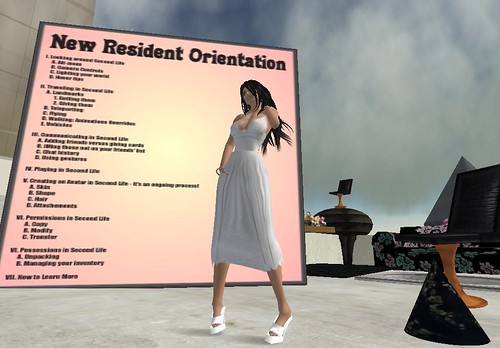
Unfortunate scheduling seems to have me logging in to SL when no one else is around in the library. So I look around at the changes, admire the architecture, sit on a cushion, look at a shelf full of books I can't read, and soon log out again. The librarians probably come around later, you know, West Coast time or East Coast time, and have big trainings and massive chats. Learning from each other, they postulate on building better virtual and digital library resources and services. And that's great.
But where are the patrons?
Where are the patrons, and what do they think when they come and look around? When they click a really great link on the reference terminal that takes them to a website in a web-browser outside of the SL environment, do they wonder why they bothered? When they can't find books -- or worse -- when they do find books but realize they'd be happier sitting on the couch with a physical book, a beer, and a cat? What happens then? Do the patrons wonder why the hell there's a library in SL in the first place? Do they wonder what the point is, or am I missing something? Certainly SL Library isn't a case of librarians letting their normally quashed vainglorious sides take a peacock walk through ubernerdling land...
I learn lots from librarians -- from talking to them, observing them, from reading library publications and blogs. But I think I learn even more from my patrons. I learn the patrons' needs, preferences, habits and tendencies. I learn why the patron was unhappy that she didn't find what she needed so that I can help get her to the resource that does have what she needs next time.
How can SL Library mature without real need from patrons? How can SL Library become meaningful and relevant?
If these questions are answered well (and I hope that they can be), I think it will shine a real ray of hope on the future of libraries generally.
Tuesday, July 25, 2006
ancient book of psalms in irish blog. er, bog.
The really sad thing? I first read this as "ancient book of psalms found in Irish blog".
--
speaking of psalms...
--
speaking of psalms...
google mandarin, beta
Yes. Just did a little experimenting, and it looks like Google's translator will now tackle Chinese. This is new to me, and it makes me happy. I can finally Baidu.

waggin' my chinese
Taking a cue from Dr. Nokes at Unlocked Wordhoard, I think we've got a Chinese ISHUSH on our hands. There's a "beta" translate button in Mandarin beside your Google search results when you use the google.com.cn interface to search for roman lettered words now. Another minor synchronicity. I've been feeling an odd itch to learn that language since I got back from Free China a couple of years ago (never felt much of a pull to learn it while I lived there...). Maybe one of these days I'll take the urge seriously and start practicing my tones.
carnival 47
Yo. Next week we'll have a round of the Carnival of Infosciences seated here, at ISHUSH. If you'd like to submit, please email me { kdevans {at} gmail.com }. The Carnival gets in on this coming Monday morning, 30 July. Send submissions by Sunday, please, and without much straggle.
But don't worry. Even if you're late, the rides run all night long.

But don't worry. Even if you're late, the rides run all night long.
virtual reality and time travel
Quick note.
Thinking on the uses of a virtual reality -- or augmented reality, actually -- and thinking that to me, in my life, one of the best applications would be the ability to spend lots of virtual or augmented time doing something, and have that something take up very little "real" time. To have my mind affected by the VR or AR process in such a way that I could use three seconds of real time to read a chapter of a book, practice playing the guitar, or post a blog entry. Like they did in the Matrix, but not quite as "jacked in" -- more on-the-fly like. More ad-hoc. Like you could use the time you were sitting in traffic at a red light to complete the Chen Style taiji long form, then snap right out of it and get your truck in gear and go.
Dilating and contracting time as you go, as needed, to learn new skills or accomplish tasks.
That'd be great.
Thinking on the uses of a virtual reality -- or augmented reality, actually -- and thinking that to me, in my life, one of the best applications would be the ability to spend lots of virtual or augmented time doing something, and have that something take up very little "real" time. To have my mind affected by the VR or AR process in such a way that I could use three seconds of real time to read a chapter of a book, practice playing the guitar, or post a blog entry. Like they did in the Matrix, but not quite as "jacked in" -- more on-the-fly like. More ad-hoc. Like you could use the time you were sitting in traffic at a red light to complete the Chen Style taiji long form, then snap right out of it and get your truck in gear and go.


Dilating and contracting time as you go, as needed, to learn new skills or accomplish tasks.
That'd be great.
Thursday, July 20, 2006
From a January posting at Presentation Zen:

In this horribly embellished image above, Darth tries to get Luke to capitulate and join forces by presenting in an "evil PowerPoint style." We know in this galaxy, though, that this approach never really works.

Size and age matter not. Might Yoda take a more "naked" analog approach?'
--
Hmmm. Trying to figure out if and/or how this might be applicable to my library instruction classes.
In the current instantiation, my class is more like Vader's .ppt. What might be the uses of Yodafying things? And how?
Lessee. Establishing the student/teacher ontological framework might be a start. Why did you come down to muddy old Dagobah from your lofty classrooms? (Take the quiz, man, and see the need you have for this.)
And, after all's done, let's leave early, get away from this smartboard, go out to touch some books, smell them, see that this is a 'real-time' and 'meatspace', Here & Now kind of situation-- not some murky future promise of glory to be had through the Dark Side of cut-n-paste, plagiarism, and shallow understanding. Not some airy-fairy ethereana that will let you slide through your classes without a deeper understanding of the material, nono.
Here and now. Do, or don't do.
'Contrasts in presentation style: Yoda vs. Darth Vader
Edward Tufte says: "PowerPoint is Evil." This got me thinking... What if Darth Vader — my favorite fictional bad guy — gave a formal presentation? How would it look? How would it compare to the presentation style of Yoda, the wise Jedi master?In this horribly embellished image above, Darth tries to get Luke to capitulate and join forces by presenting in an "evil PowerPoint style." We know in this galaxy, though, that this approach never really works.
Size and age matter not. Might Yoda take a more "naked" analog approach?'
--
Hmmm. Trying to figure out if and/or how this might be applicable to my library instruction classes.
In the current instantiation, my class is more like Vader's .ppt. What might be the uses of Yodafying things? And how?
Lessee. Establishing the student/teacher ontological framework might be a start. Why did you come down to muddy old Dagobah from your lofty classrooms? (Take the quiz, man, and see the need you have for this.)
And, after all's done, let's leave early, get away from this smartboard, go out to touch some books, smell them, see that this is a 'real-time' and 'meatspace', Here & Now kind of situation-- not some murky future promise of glory to be had through the Dark Side of cut-n-paste, plagiarism, and shallow understanding. Not some airy-fairy ethereana that will let you slide through your classes without a deeper understanding of the material, nono.
Here and now. Do, or don't do.
Wednesday, July 19, 2006
dirty books, gross keyboards, continued
Hey, it's worse than you thought. Many of you have surely already read David Rothman's post on "Library Keyboards and Public Health" -- if not, please go have a look! Time to get paranoid and reactionary about the creepy-crawlers cloying to our keyboards and clinging to our mice. The Krafty Librarian wrote about it too.
The bad news from the article David mentions is: "Potential pathogens cultured from more than 50% of the computers included coagulase-negative staphylococci (100% of keyboards), diphtheroids (80%), Micrococcus species (72%), and Bacillus species (64%). Other pathogens cultured included ORSA (4% of keyboards), OSSA (4%), vancomycin-susceptible Enterococcus species (12%), and nonfermentative gram-negative rods (36%)."
The good news was: "All disinfectants, as well as the sterile water control, were effective at removing or inactivating more than 95% of the test bacteria." So cleaning them works.
--
Thanks David!
The bad news from the article David mentions is: "Potential pathogens cultured from more than 50% of the computers included coagulase-negative staphylococci (100% of keyboards), diphtheroids (80%), Micrococcus species (72%), and Bacillus species (64%). Other pathogens cultured included ORSA (4% of keyboards), OSSA (4%), vancomycin-susceptible Enterococcus species (12%), and nonfermentative gram-negative rods (36%)."
The good news was: "All disinfectants, as well as the sterile water control, were effective at removing or inactivating more than 95% of the test bacteria." So cleaning them works.
--
Thanks David!
dirty books
I love this post at Pegasus Librarian.
"...While shepherding them through exercises to give them practice with print and online resources, one of my coworkers overheard a student saying, 'I hate books. They're so dirty.'"
Ha! Meatspace, huh. A disgusted shudder as the student contemplates meeting a friend in "real-time", too.
It goes on to wonder at how dirty the dusty books really are versus the microbe-rich environment of computer keyboards. Anybody happen to know what the rate of infection for either or both is, by the way? Curious.
Rock on with your day now.
"...While shepherding them through exercises to give them practice with print and online resources, one of my coworkers overheard a student saying, 'I hate books. They're so dirty.'"
Ha! Meatspace, huh. A disgusted shudder as the student contemplates meeting a friend in "real-time", too.
It goes on to wonder at how dirty the dusty books really are versus the microbe-rich environment of computer keyboards. Anybody happen to know what the rate of infection for either or both is, by the way? Curious.
Rock on with your day now.
8 teaching
You get good teaching days and bad teaching days. On Monday, I had a good class and an ass class.
I'm prone to get hostile toward dullards. And, on reflection, the students can be the problem. So what I've come to is that my students need a stake in my class. A good reason to listen up, ask questions, take notes; ideally their instructor would provide such a reason before hand. I only get one hour with them during the semester -- just a quick bang and blame -- but I've got to establish roles and purpose in the first minute or so.
My wife, an ESL teacher (and a bloody good one), passed along an idea she picked up in a citizenship class -- hand out a tough quiz. Like, "Hi, I'm Woody Evans, a librarian here, and today I'll be showing you how to use the library to find the info you need to write a good research paper for your class. Now break up into groups of three and do this quiz. We'll go over the answers in about three minutes from now." And the quiz is, say, a dozen multiple-choice questions about which database does what, using multi-volume reference books, a touch of old Boolean logic, truncation. After running through the answers to it, the students ought to have an immediate, tangible, vested interest in being with-it for the duration of my class. Right?
So we'll see how that goes.
Anotherimportant vital part of this process is involving the instructors. I've got to start making sure that the students are clear on exactly what the hell the assignment is before they show up in my library to get a detailed explanation on how to use tools that they don't know why they'll need. That is, the instructors have to give them a good reason to be there, too.
Who's up for an hour of detailed chainsaw engine troubleshooting and repair? It's only boring if you don't need the firewood.
I'm prone to get hostile toward dullards. And, on reflection, the students can be the problem. So what I've come to is that my students need a stake in my class. A good reason to listen up, ask questions, take notes; ideally their instructor would provide such a reason before hand. I only get one hour with them during the semester -- just a quick bang and blame -- but I've got to establish roles and purpose in the first minute or so.
My wife, an ESL teacher (and a bloody good one), passed along an idea she picked up in a citizenship class -- hand out a tough quiz. Like, "Hi, I'm Woody Evans, a librarian here, and today I'll be showing you how to use the library to find the info you need to write a good research paper for your class. Now break up into groups of three and do this quiz. We'll go over the answers in about three minutes from now." And the quiz is, say, a dozen multiple-choice questions about which database does what, using multi-volume reference books, a touch of old Boolean logic, truncation. After running through the answers to it, the students ought to have an immediate, tangible, vested interest in being with-it for the duration of my class. Right?
So we'll see how that goes.
Another
Who's up for an hour of detailed chainsaw engine troubleshooting and repair? It's only boring if you don't need the firewood.
Tuesday, July 18, 2006
happy birthday, whoever you are
If you need a lift, have some old school Vector Park. It helps.

--
Shushing: everybody in the world but my wife (that means you).
Reading: Majestic Journey: Coronado's Inland Empire by Udall.
Linking: Non Agnostic.
--
Shushing: everybody in the world but my wife (that means you).
Reading: Majestic Journey: Coronado's Inland Empire by Udall.
Linking: Non Agnostic.
Subscribe to:
Posts (Atom)