Thursday, May 25, 2006

comics 5

Further notes on comics (and games):

* My wife did go back to that comics shop with me. They have a really big, cool collection of all kinds of games -- she wanted something to play in the pub that afternoon. It was a a calm, quiet, Friday afternoon. Just a couple of other people in the shop (one was female, by the way) drifting through the back issues and the pewter minatures. The manager with the funny hat was still in a funny hat, but he stayed well out of our way. My wife picked "EcoFluxx", which turned out to be a fun one, and we went haunted haunting the pub for a while, playing, then went and haunted our Bubble Tea joint for a while, playing. On the way out of the shop she said, "Well, that was much better."

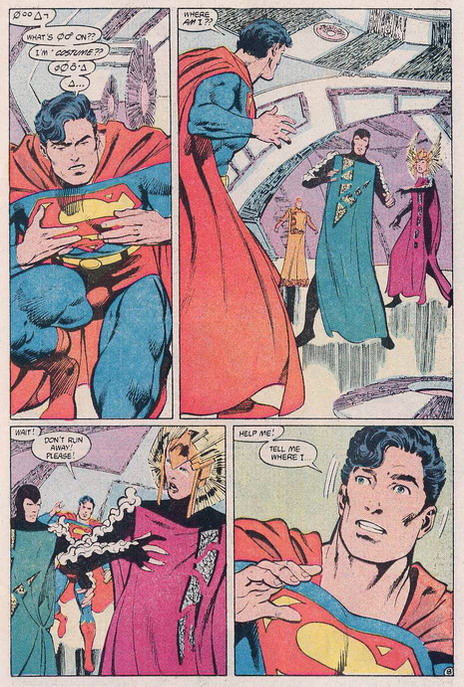
* I'm watching the old Superman movies again at home (I didn't realize that I was doing it in preparation for the new movie due out soon, but I am!). My wife noted how excited she gets, watching them. Me too. I remember how cool they were when I was a boy -- and, be damned!, they're still cool. The new movie has a lot of work to do if it's going to compare. Superman 1 really set the Kryptonian aesthetics perfectly -- the complex, jagged, crystalline structure of everything (that would later get folded into a robust, knotty, almost-tangled look under John Byrne's pencils in the comics) ...there was a kind of "smart stuff" or early "everyware" aspect to the way [Kryptonian] things looked in both the movie and with Byrne's take. It highlights their technological acheivements, and that heightens the tragedy of their doom. Awesome.


* Back to games for a minute. Comics and games seem to go together, somehow. What is it about them? In gaming you can become like the characters you read about in comics (of any genre). Games are a way to "do something" about unsolvable problems, too, in a way. More important than that, in my mind, is the transformative and "magickal" power of gaming -- to look squarely at a usually-hidden aspect of yourself in the context of a cooperative fictional environment and make that "self" do whatever you Will within the bounds of the agreed upon rules. I don't think magick is a big or important part of gaming culture, however... and maybe it's more effective as magick if the magick remains mostly hidden. Anyway.

* Games aren't gender-divvied, are they? Seems like I see throngs of both girls and boys playing the Yu Gi Oh or the Pokemon in the bookstores on the weekends. And everybody loves Scrabble and Monopoly and Poker, right? What about table-top RPGs? Still the domain of men? It's just interesting to me that games drew my wife back to a comic shop she swore off of. Looking for a game -- a cool game, not just Connect Four or something, but an unusual, under-the-radar, bottom-shelf, small press, game. She was looking for something obscure, see, and the best place to browse for off-beat games? You know. The comics shop. Now how does this play in the the bigger conversation about comics shops? Will games be (or are they already, or have they already been) a factor in getting more women into comics shops? And if they come seeking games, why not just go to a "game shop"? Comics and games seem to go together, somehow.

* For librarians... I again must stress the importance of collecting and promoting this stuff. Gaming books and graphic novels are hot, hot, hot, and it's not a passing fad. This has had and will continue to have staying-power. Design your programs (for any age groups) around these materials and watch a loyal community grow up around you. Go read PopGoesTheLibrary -- they know what's up. And, by the way, this isn't any kind of acquiescence to "low brow" media. Comics are full of advanced vocabulary and complex plots. Comics and games are good for kids (and grownups). You know that, don't you?

--

Weather: Finally cloudy.
Shushing: My insurance company.

obit: Ian Copeland of IRS Records

Here's an obituary for Ian Copeland from Surviving The Golden Age:

"Today is a sad day for many in the London and Georgia music scene. IRS co-founder and Georgian concert promoter, Ian Copeland has passed away from Melanoma at the age of 57. Ian is accredited with launching the careers of bands such as the Police, R.E.M., the B-52s, and Squeeze.


Ian's brother Miles Copeland founded IRS records and enlisted Ian to bring Squeeze to the states. Ian made Squeeze a hit in the states by booking them a long tour schedule of smaller night clubs. Ian later brought his younger brother's band, The Police to the states. Ian created what is now referred to as the "club circuit".

Later Ian started Frontier Booking International (F.B.I.) which booked for bands like R.E.M., The Bangles, Adam Ant, Nine Inch Nails, and the Dead Kennedys..."

*

At the post, there's a live R.E.M. set from 1982 in .mp3 files.

--

Listening: 1,000,000

Tuesday, May 23, 2006

info viz 4

A couple of info viz notes:

See a map of Amazon's books:


Weird. Fun.

--

Text represented as "binary signs" for the spaces you move around in:


This one puts me in mind of Semacode again, and makes me wonder about the possibilites of using ambient machine-readable markers in our spaces to link our machines with information. Kind of like a "magic eye" for computers that whisks the patron away to rich info resources.

--

Both found via http://infosthetics.com.

mls, mlis, certification

|UPDATE, Sep 07|

My thinking on this continues to evolve. What I wrote below was in part motivated by long years of observing dedicated library employees with very professional attitudes and great knowledge of sources and technique being treated sub-professionally. But the degree itself needs to be worth something and it should mean something -- it should be a qualifier without disqualifying those who work hard without it.

---

The graduate "library science" or "information and library science" degree is a funny thing. I worked in libraries for almost 10 years before I got the MLIS, and I think my experience taught me far more about how libraries should operate than the degree did.

The degree is a kind of initiation into "professionalism", and for all the great instruction (and independent research and practicums -- and I mean in no way to deny the value of what gets taught), the culture of the title "librarian" seems often to be more important than the practice to too many of my peers, these days.

The degree, too, is a period of intense thinking about and writing about libraries -- and that was utterly useful to me. It changed my life. But it's not the only way to go.

See, I hate this word "paraprofessional". It's demeaning. It means something to the effect of "on the side of" or "with" in the old Greek. The non-degreed librarians that I know (and have known) daily take the lead on matters of policy and customer service, and in the operational smoothness of our libraries -- while the "professionals" are in the background shaking hands with deans or city council members, brainstorming on programs, ordering books and doing other (very essential but usually less immediate) work. In reality, it's librarians who are alongside them, and not the other way round.

I think there should be a certification program for librarians, to grant "librarianship" after a period of practical experience, a few short (short!) courses, and test of some kind. A full-on "postgraduate degree" isn't necessary, especially when you consider the fact that this really is a sort of professional (as in more-professional-than-academic, as in more focused on the career or the profession of librarianship than it is on advancing the general body of knowledge related to information science... c'mon) and beuracratic hurtle. The degree is in most cases just a gate guard for administrators.

Librarians and libraries shouldn't be about that. 15 years of practical know-how should be worth far more than 4 semesters of online classes, a couple of field trips, and a piece of parchment. "Librarianship" shouldn't be so zealously guarded by the bean-counters when there are so many bright and able people who deserve advancement and would be considerable boons to our libraries. Some kind of certification program would solve these problems and get more people in the gate.

This "librarian" thing isn't a Sunday garden club, you know. Let's look at our assets -- at our dedicated "paraprofessionals", and let's train them up and certify them and put them where so many of them belong -- in leadership roles. Librarians could stand a bit of a de-high-horsing, and "paraprofessionals" could really stand to be looked at anew for what they are: professional.

--

Watching: Emmanuel's Gift
Listening: Squarepusher: Big Loada
Surfing: UFO crash: Aurora, TX, 1897

Monday, May 22, 2006

Via Lisnews.org:
"The Australian Federal Government may ban the sale of "hate books" and outlaw the glorification of terrorism. Islamic books that support violent jihad can be sold because sedition and incitement laws do not specifically ban them, according to legal advice to the Australian Federal Police.

Well this does go some way toward the concerns expressed in an earlier post. And this post (link), which deals with banned books in the U.K.

I really feel that this is coming our way, folks... It won't be long before the U.S. follows suit and starts outlawing books. Or, to be more accurate, outlaws the manifestation of ideas that are deemed dangerous to the state, whether in book form or whether spoken aloud in lectures.

Wednesday, May 17, 2006

da vinci code debate

I haven't read The DaVinci Code yet... I might get around to it some day, but I'm more interested (and have been for years) in what Stephen Hoeller has to say about church origins than I am in what Dan Brown says about it. I don't mean to knock Mr. Brown -- I haven't read any of his novels. But if we're arguing about doctrine and history, let's go to the historians and theologians, no? Instead of the novelists? It's like, you know, entertainment and education aren't exactly the same thing.

There's a metaphor now loose, though, and what ever mean-eyed arguments may continue erupting around the novel (and now the movie), it will be very dangerous to lots of Christian faithful -- the metaphor is something like "Christ is in us & he always was". Something like that.

Will believers go to their libraries and look deeper than the pro and con shout-down-books? Will they read the Nag Hammadi scriptures, and decide for themselves? Our patrons are better off (that is: better enabled to dig deeper and empower their own arguments for or against the "code") if we dig a little deeper too... Pull out the Margaret Starbird alongside The DaVinci Deception... Put out the Bethany House stuff alongside the Disinformation guides...

For my part, the fact that so many people have called for the movie to be censored pretty much guarantees that I'll go watch it. Are they trying to get me to see it? I don't cotton well to being told what information I shouldn't have access to... and if I like the movie, I might just read the book after all.

--

Watching: Ask A Ninja: "Net Neutrality"

Tuesday, May 16, 2006

image problem?

LISNews.org reports on a couple of famous authors (Rowling, Rushdie) getting out to support public libraries. It seems that libraries in the U.K. have an image problem?

In the Guardian Unlimited article that the story's drawn from, Alain de Botton is quoted: "It's in walking into a library that most people first get the sense of how little they know... Surrounded by so many books, we are liable to feel how great our ignorance is, next to all the accumulated wisdom and insight of others."

Huh. Don't quite know how to respond to that... except to say that I hope that's not the cause of Britons' avoidance of libraries. I don't agree with it -- I lived in England, and I never got the impression that folks were scared of their books, or intimidated by the insights of others. If that is the problem, they've got bigger worries than dwindling library circulation. Anybody know more about this issue?

"ideological exclusion"

Via The Kept-Up Academic Librarian:

"Since passage of the USA Patriot Act after Sept. 11, 2001, a number of academics have been denied visas or had them revoked. Universities and scholarly associations have written letters to the government to no avail."

So foreign scholars are being kept out of the U.S. seemingly because some in the government are worried about what they might say (link to Christian Science Monitor story) to us Americans. The DHS claims that these academics are kept out because the Patriot Act's section 411 gives the government the power to exclude anyone who espouses or endorses terrorism.

How long before we librarians are given a list of illegal books -- books that are said to espouse or endorse the viewpoints of terrorists? And since the t-word has such a broad definition, I reckon we'll all have lots and lots of weeding to do.

See also: Patriot Act in the U.K.

meta / universal library

In a previous post, I went daydreaming about a sort of universal library. Kevin Kelly's "Scan This Book!" just over at New York Times Magazine is a good overview of the dream of a "universal library", a library collecting all information in all media (across all time). Of course such a thing is impossible, despite the apparent optimism in Kelly's article -- and I think he makes the complexities of implementation abundantly clear. See also The Gypsy Librarian for more good questions about this subject. Angel is right to point out the obvious hitch in these bold dreams: not many of us, on balance, have computers.

I don't think it's possible to detangle the politics from the question of universal access. Kelly doesn't get into it, but there is a reason (besides the obvious technical and litigious barriers) that such a universal library doesn't exist. There's a reason that such a library will probably never exist. Simply put, it's not in the interest of the powerful to allow universal access to the world's information.

Not until the nature of "power" and leadership is radically altered will true empowerment for all people be seen as a good by the world's governors. It would take a true democracy, at least (if not an even more radically distributive and open system), in which "all" the people who have an interest in access are able to legislate and execute such access for themselves -- in other words, a system where every person actually has meaningful self-governing powers.

We're lucky that we can even have such conversations about the possibilities of universal access -- most aren't so lucky. And Google as the great enabler? Google censors searches in China to keep cozy with those in power. As long as it makes better political/business sense to keep people and information apart, this "universal library" won't be possible.

Who benefits from a universal library? Who takes a hit when we get the information to the people with impunity, or when people get the information to themselves? File "universal libraries" under post-Singularity daydreaming.

But that doesn't mean we have to give up.

--

Watching: Harold Bloom on BookTV
Feeling: churlish as hell
Surfing: swish-e.org

Sunday, May 14, 2006

homework, librarians

Basic information literacy skills: for any book, website, lecture, film, e-mail, or conversation, you've got to be able to determine if it's accurate, authoratative authoritative, current, objective, and what the scope of it is. At least that's what we like to teach our patrons around here: think critically about your sources.

Here's a spot of homework, then... does the following video (embedded from Google Video -- 9/11 Loose Change - 2nd Edition) meet these criteria?

Thursday, May 11, 2006

the singularity summit at stanford

If you're in the neighborhood on May 13th (that's this Saturday!), check out the Singularity Summit at Stanford. What's the singularity? "In futures studies, the singularity represents an "event horizon" in the predictability of human technological development past which present models of the future cease to give reliable or accurate answers, following the creation of strong AI or the enhancement of human intelligence. Many futurists predict that after the singularity, humans as they exist presently won't be the driving force in scientific and technological progress, eclipsed cognitively by posthumans, AI, or both, with all models of change based on past trends in human behavior becoming obsolete," say they.

I'd go if I could. Click image below to read about the speakers.

Wednesday, May 10, 2006

thinglink: more toward spimes

You've heard of Thinglink? It's one clever way to help realize that "ultimate geek dream of knowing where all your stuff is", to paraphrase Bruce Sterling quoting Warren Ellis. And it looks like a lot of fun. It taps the Make crowd, and they're a fun lot, for sure.

Does this stuff mean that all librarians are to become archivists of a kind? And are all physical objects (realia, in the parlance of catalogers) to become informational? Metadata for every pen and shoe and coffee cup and knitted pillow case on the planet? Or can we just skip the prentense and let librarians go the way of last-century's secretaries? (I don't think so.) More on this later.

Here's the video of Ulla-Maaria Mutanen talking about Thinglink, how it works, and a little about what it may mean. ...Every book/thing its reader. (And let's have a round of applause for ANT, while we're at it... it's high time it got a little more play.)


--

Feeling: very, very distracted

Monday, May 08, 2006

info viz 3

via Sukhdev's World, we find the InfoVis Wiki:

"The InfoVis:Wiki project is intended to provide a community platform and forum integrating recent developments and news on all areas and aspects of Information Visualization.

Using editable–by–anyone Wiki technology turned out to be the only way of keeping the presented information up to date and knowledge exchange vivid."

--

Listening: Alan Moore (et al) The Highbury Working
Next is: Angel Passage

comics 4

I made the mistake of taking my wife to a comics shop. I should have known better.

It was "Free Comic Book Day" this last Saturday, and I went in the afternoon to surf around for a new book, and, you know, support the medium. I found Shaolin Cowboy by Geof Darrow, and was mighty pleased. I also noticed some little wind-up robots (Kikkerland gadgetry!) on the way out, and they got to bugging me to the point that I decided to go back and buy one on the way to get groceries with my lady.

She hates comics. I've suggested Blankets, Ghost World, Orbiter, A Distant Soil, others, but she just can't get into them. Part of it, she admits, is a prejudice toward the key memes of the medium -- the capes and tights and muscles-for-justice. Part of it is that she thinks women are overly sexualized in comics... We debate this point (including the traditional oversexing of men in comics) about once a month or so. The sad thing is, she mostly right, because most comics still insistently truck in such dreck (so the brilliant stories get obfuscated by what's marketed to 13-year-old-30-year-olds).

So we go into the comics shop and I pick up my robot (okay, yes, my toy), and we're waiting quietly in line to buy the thing when the manager dons a black and purple belled jester's cap and addresses her, like, "Heeey! This is free comics day!! You can't have your hands in your pockets in a comic shop! Don't you wantafreecomic??!!" and starts jangling his cap, like he's talking to a 4 year old. All the folks turn to look at my wife.

She holds her own, says "No thanks. I don't even like comics." But the guy keeps blathering on and on. I butt-in and cut him off, saying that I've already got too many comics, yada yada, that I've already been in once today, yada yada, and that deflects attention from her. Cool.

Then when I actually check out, the cashier makes some kind of allusion/joke-thing about "Stargate: SG-1" and I don't follow the show, and my wife doesn't follow the show (we don't get channels, even, we just rent DVDs), so we're lost, but he's cracking up. Here's the money, thanks, bye, you've managed to out-nerd me. Congrats.

We step out to the sidewalk and she immediately says "I'm never going in there again."

Alright. Pause. Take a breath.

Librarians, notice!

This is the part where you think: "Gee. Most of the patrons who check out graphic novels from my library are teenage girls. Granted, they're almost exclusively taking out the manga love stories and teeny romance tales, maybe with just a dash of The Sandman or somesuch sometimes... But he's right. Comics shops are usually male-only domains. Why don't girls feel comfortable in comics shops, but very comfortable getting comics from my library?"

And this is the part where comic shop managers should take notice.

Most new readers are female, and most are young. That means that if you get your act together, wipe your noses, and make your stores inviting to the young woman demographic, you might just garner yourselves some lifelong customers. And you might just be doing your part to rescue the medium from itself.

Others have been writing about this for some time (see Warren Ellis' Come in Alone for a very good example), but I'm yet to see much change. Comics are absolutely going to suffocate in their own excrement of control fantasies and sexual fetishism unless alternative kinds of stories, styles, values, and aesthetics come to be celebrated, and come to be the touchstone in what we mean when we say "comics" -- and this needs to happen soon.

Now what can comic shops learn from librarians about cultivating a strong comics customer base?

  • Libraries aren't dingy, musty, dusty, and dark.
  • Libraries don't encourage groups of grown men to hang around cuss the %@#$ out of each other over the subtler points of orcish armor in D&D 3rd ed.
  • Libraries offer lots of kinds of stories in lots of formats -- not just superheros and hentai.
  • (and here's the main point) Libraries aren't creepy -- they're not the kinds of places where everyone leers when a girl (OH MY GOD, A girl...) walks in.

Obviously, not all comic shops are so bad. And superhero stories can be fun, for sure. I don't mean to throw it all out.

But a little sunlight and and a little cool music and a little bit of Bubble Tea culture would go a long way towards encouraging girls and women to pay a visit to the shop. A little less uber-nerdlingness and a little more of a "your you're cool, we're not creepy, please enjoy your visit" attitude in the shops would go a long, long way too.

It would have made all the difference to my wife on this last Saturday.

--

Listening: Paulo Conte

Friday, May 05, 2006

info viz 2

From NASA -- A .mov of the Cassini-Huygens Orbiter's Titan Descent Probe drifting down to land on the surface, with an accompanying wondermous little MIDI song...

Click on pic to view:


Now that's info viz done right.

they're made out of meat

If you've got 7 minutes or so, here's a weird, funny, short film adaptation of Hugo and Nebula Award winning author Terry Bisson's short story "They're Made out of Meat":

Thursday, May 04, 2006

libraries save worlds

I'm not a banker or a farmer; I'm a librarian. I don't know how to distribute micro-loans in Chad, or tinker with a heartier species of millet. I know books. Can libraries really save worlds? I want to believe it.

What can libraries do?

. Get the information to the people -- broadly and universally.

. Fend off censors -- be they religious or political.

. Support literacy -- for all ages, across any medium.

. Preserve cultural history -- we're the information bank, and we are long-term memory.

. Spur trust -- mix readers with programs and events.

If we can do that in every country, we can make headway in defeating evil in this world. Evil? I'm a pragmatist. Whatever the root causes may be, evil occurs. Libraries represent a universal ethos of liberalism, pluralism, discovery, and the conservation of knowledge. Libraries work for good, or they should.

The long term plan? Sustainability? 10,000 years ahead? We're part of that. You do it every day.

I keep coming back to the question, despite or because of the hunger and the war and the rape: how do we put a library in every village in Africa?

And I must be embarrassingly naive. I've e-mailed librarians in Sudan and Egypt and elsewhere, asking questions, seeking contact. They don't write back. They're busy with bigger problems. Libraries in every village? How about clearing the flies out of our children's eyes first.

Jesus.

This is going to take legwork.

Wednesday, May 03, 2006

info viz 1

Check Information Aesthetics for many nifty tools that let you see data turned into pictures. It led me to my new favorite toy: Globe-i from Infomagnet. Globe-i lets you turn economic data into 3-d charts on a spinning model of the Earth, like this (a viz of the % of imports from Indonesia by country):


Info Aesthetics is constantly linking to very interesting (and sometimes quite useful) vizualization tools -- like this "Sector Snapshot" Utility from the New York Times business section.

--

Playing: LEGO-StarWars, fool!

an inconvenient truth

I'm from Mississippi. I love Mississippi. Mississippi is a slightly coastal state (kind of north-west of Cuba). I've got family still living in FEMA trailers (and this is 3 May 2006).

Which is a preferatory note to say that I'm perpetually interested in what the big-hairdos in our halls of power have to say about "global warming". So I'm going to see Mr. Gore's take on the subject by way of his movie An Inconvienient Truth (FYI, here's a link), in hopes it indicates a shift of priorities in re: global warming amongst the hairdo crowd, and out of curiousity.

--

A few "global warming" resources I've found to be of use:

For Kids:
http://www.epa.gov/globalwarming/kids/
http://www.exploratorium.edu/climate/index.html

Climate change items from NOAA:
and http://www.noaanews.noaa.gov/stories2006/s2622.htm
and http://lwf.ncdc.noaa.gov/oa/climate/severeweather/extremes.html
and http://lwf.ncdc.noaa.gov/oa/climate/globalwarming.html

Kyoto Protocol:
http://unfccc.int/essential_background/kyoto_protocol/items/2830.php
http://unfccc.int/methods_and_science/items/2722.php

Documenting change:
http://www.glims.org/MapsAndDocs/

Union of Concerned Scientists:
http://www.ucsusa.org/global_warming/solutions/
http://www.ucsusa.org/global_warming/science/global-warming-faq.html

--

I like my books dry.

libSOS

I've started a sister blog to this one. It's called libSOS (for "library SOS"), and it's all about "Hacks for Librarians. Shortcuts, freebies, sharables, good ideas, quick tips, tricks, suggestions, and hopeful notions for underfunded d.i.y. librarians who live somewhere on Earth and need to get the information to the people."

The idea is to make info available for tinkering, modding, tricking-out, re-vamping, and skin-of-teething for librarians who lack the funds or support they need to get the information to the people. The aim is to share ideas that let us get the information to the people despite the challenges we face.

I hope that posts will range from the very specialized (skirting Sharia law to distribute books in Khartoum) to the universal (repairing a torn page with home-made paste).

I haven't seen anything like this elsewhere, but if I've missed it give me a shout -- and feel free to, too, if you have suggestions or want to share a tip.

The blog is http://libsos.blogspot.com

--

Shushing: book burners