Tuesday, June 13, 2006

interview: James Hughes: Techno-social Changesurfer

Following is an interview with James Hughes, sociologist and transhumanist of note, and author of Citizen Cyborg (Westview, 2004).


--
> 1. What's new with you?


Yikes. About fifty things a day. I feel like I'm about to be swept under by accelerating change all the time. Need to spend more time on my meditation cushion.

But some things at the top of the agenda:

- Following up on our successful Human Enhancement Technologies and Human Rights conference at Stanford, May 26-28, with a new set of priorities and programs to propose to the IEET and WTA directors
- Helping with the Transvision conference in Helsinki August 17-19
- Working on a second book called Cyborg Buddha
- Trying to pull together a book on technoprogressive social policy for the IEET
- Writing various essays and chapters
- Consulting
- Parenting
- Clearing brush from my yard and trying to fix my hot tub


> 2. What is transhumanism, and why does it matter?

Transhumanism is the merger of our oldest and deepest aspirations to transcend the limiitations of our mind and body, to be wiser, happier, healthier, longer lived and to have more capabilities, with the democratic values and scientific culture of the European Enlightenment.
We advocate for everyone's right to use safe human enhancement technologies even if we move beyond some people's limited ideas of what humans are supposed to be.


> 3. In recent e-mails, we were talking about the relationship between transhumanism and Buddhism. Can you suggest a few points of synthesis between the two? A few points of fission?

Buddhism is a faith tradition and set of spiritual practices whose core idea is that human beings can become more than human by application of mental technology and self-discipline. As such it is probably the most compatible of the older faiths with transhumanism. But it is also quite
challenging for many transhumanists in its insistence that there is no discrete, continuous ego that could be protected and perpetuated. Many of the immortalists, for instance, find that a threatening idea, but I think we will increasingly see the truth of the emptiness of the self as
we apply neurotechnologies and life extension.


> 4. If I may say so, it looks like we'll all be speaking Mandarin in 100 years. How do China's global (and extraterrestrial) ambitions impact the transhuman agenda?

One of my nightmares is an authoritarian China using coercion to achieve the full benefits of enhancement technologies for their population, and using neurotechnologies to remold their citizens into compliant workers and soldiers. The answer of course is not for the West to ban these technologies, but to make them as widely available to free people to use in freely determined ways, so that we get the even greater advantage to be had from a billion individual experimenters. China also highlights the importance of a global campaign of democratization and political globalization, to ensure human rights, democratic accountability, collective security and fair, sustainable development. Only a democratized world united around a democratic, accountable transnational authority can stand down the new forms of enhanced authoritarianism we are sure to see.


> 5. In the broadest sense of the word, will posthumans need libraries?

Yes, but electronic ones of course. Although some people will still want to read physical originals, I think books and journals will be transcended by richer, more complex and hyperlinked electronic media, engaging all the senses in ways just hinted at by virtual reality games
today.


> 6. There seems to be some really exciting academic work going on that's affiliated with or carried out by transhumanists -- looks like everything from ethnography and gerontology to nanotechnology and engineering. What are the fields that most excite you, and why?

One of the advantages of being a sociologist is that I can legitimately follow and be excited about everything. Like everybody else, my personal hopes for life extension and medical progress focus much of my attention there, and I'm trying to get more knowledgeable about cognition and neuro-physiology for my book Cyborg Buddha.


> 7. I listen to your Changesurfer Radio, and have enjoyed it for years. There's no denying that you're a science-fiction fan, is there? Who are you reading right now?

Just finishing the 1600 pages of Peter Hamilton's Pandora's Star and Judas Unchained, which projects a very plausible transhuman future and polity under serious pressure, implacable threat from hostile aliens. Precisely the kind of imagining we need for the challenges ahead. Next up is Ken MacLeod's Learning the World and Verner Vinge's Rainbow's End.


> 8. Okay. I want to ask you about military and police applications of the transhuman or posthuman vision. The notion of a world in which the world's major states have bundled the technology up and use it to control their populations and wage wars against each other is pretty scary. How can the transhumanist movement, and the technology associated with it, be made widely and democratically available without also making it available to criminals, autocrats, and terrorists?

We can't. We will have to weigh the risks and benefits of wide access to each technology. Making life extension tech widely available has low risks and wide benefits; yes bad guys will live a long time, but so what? Making neurotechnology widely available has more risks, so we will just have to punish those who use them for bad ends. Making nano-weapons widely available has low benefits and high risks, so I would restrict their possession to democratically accountable military and police. Etc.


> 9. Realistically, does the post-Singularity world look more like a Bill Joy or a Ray Kurzweil scenerio to you?

I have more of a cyberpunk future in mind - tech that breaks down and eats stuff as often as it works, government that is more transparent and accountable, but even more scary and destructive when it goes off the rails, people who are smarter, happier and healthier, but individual sociopaths who wreak havoc with unimaginable ease. I have faith we can
muddle through to a better place, but it will be wild and dangerous, and will require constant effort and attention.


> 10. What sort of positive collaborations can you see between transhumanists and librarians?

Librarians can buy lots of future-oriented literature and non-fiction for their libraries. Transhumanists can work to ensure that they don't get caught up in what Jaron Lanier calls "digital Maoism," proposing the complete replacement of expert knowledge by collective knowledge aggregation software, and thereby contribute to the denigration of the important role librarians and other knowledge experts play.


> 11. One more question: what sort of projects are you working on for the rest of the year?

Well these are more my agenda for the next couple of years, but:

1. Researching and writing Cyborg Buddha
2. Promoting a global anti-aging research program
3. Building the IEET and WTA
4. Raising my kids
5. Pursuing my quest to transcend sleep altogether

--

Thanks Dr. J!

Monday, June 12, 2006

hurricane initiative

Here at the dawn of the hurricane season of 2006, I offer a new program for the elimination of these threats to our values and our way of life, these storms.

I propose we pave the Gulf. Nothing but parking lot from Belize to the Bahamas, and back up to Port Orange, Florida. We need the parking and we don't need the storms. If a hurricane were yet to come in off the Atlantic into the Gulf Parking Lot, wouldn't we rather lose asphalt than American cities? Absolutely.

If this program is successful, America should build parking lot buffers extending 100 miles off its coasts from Seattle to L.A., and from Maine to Miami by 2012. Sit back and watch it work.

New jobs! Happy asphalt contractors! Fewer hurricanes! More parking! Vote for me!

the DNA of literature

From The Paris Review: Interviews:

"Welcome to the DNA of literature—over 50 years of literary wisdom rolled up in 300+ Writers at Work interviews, now available online—free. Founder and former Editor George Plimpton dreamed of a day when anyone—a struggling writer in Texas, an English teacher in Amsterdam, even a subscriber in Central Asia—could easily access this vast literary resource; with the establishment of this online archive that day has finally come. Now, for the first time, you can read, search, and download any or all of these in-depth interviews with poets, novelists, playwrights, essayists, critics, musicians, and more, whose work set the compass of twentieth-century writing, and continue to do so into the twenty-first."


--

Reading: Don Barthelme

fantastic in art and fiction

"The Fantastic in Art and Fiction" is a great image collection put together by the Cornell Institute for Digital Collections. These images are from the 'division of rare and manuscript collections' at the university library.

About the site: "...This image-bank provides a visual resource for the study of the Fantastic or of the supernatural in fiction and in art. While the site emerges from a comparative literature course on the topic at Skidmore College, it is also intended to open the door to consideration of some of the constant structures and patterns of fantastic literature, and the problems they raise. In this sense, the materials presented here may find a use among students in a variety of disciplines."


The categories: Angels and Demons, Danse Macabre, Weird Science, Bestiary, the Marvelous, the Grotesque, Posession and Insanity, Fantastic Space, Freaks Monsters & Prodigies.

--

Listening: Oumou Sangare

Sunday, June 11, 2006

black humor, if you've got the stomach for it

Via Warren Ellis and BBC News:

'The suicides of three detainees at the US base at Guantanamo Bay, Cuba, amount to acts of war, the US military says.

The camp commander said... "They have no regard for life, either ours or their own. I believe this was not an act of desperation, but an act of asymmetrical warfare waged against us."'

--

Watching: The Constant Gardener
Reading: Tarot For Dummies
Listening: Stephen Hoeller on the Tarot

Saturday, June 10, 2006

Here's a new concern of a different sort over MySpace and such sites... Our government may use them to mass harvest personal information. Via IrelandOnline:

"Online snooping set to move up a gear
10/06/2006 - 11:51:40

A US government spy agency is funding research into the “mass harvesting” of information that people post about themselves on websites like MySpace, it has been claimed.

The New Scientist said the National Security Agency, under fire recently over reports it tracked millions of American citizens’ phone calls, had backed a study on how advances in internet technology could make mining such “social networking” sites more useful.

The magazine said tens of millions of users of such web spaces could be vulnerable to online snooping.
.."

The New Scientist article.

--

And here's another from New Scientist-- an oldie -- protection of civil liberties for Britons, or another invasive attempt at a sort of 'total informatio awareness' program? -- 'DNA database "should include every citizen"':

"
The inventor of DNA fingerprinting believes every citizen's genetic information should be stored on the UK national register. This would solve the problem of some individuals being listed even if they have been cleared of committing a crime.

"If we're all on the database, we're all in exactly the same boat - the issue of discrimination disappears," says Alec Jeffreys of the University of Leicester, UK...

Jeffreys says a complete national database should be controlled by an independent body and be limited to storing DNA information that only permits an identification - it should not carry DNA data that could be used to infer appearance, or susceptibility to disease."

--

The DNA in the UK issue is a tad different, but it's related; the sad thing is, I think a lot of us have had the attitude for some years that "the government" or corporations are already doing this sort of information gathering and using it to make more money or to seat themselves more securely in control. "They've" got the means. Why not do it? What oversight?

Self censorship is in style again. Yee-ha.

--

Searching: For other songs by Remy Zero besides that one they used on Smallville.

Thursday, June 08, 2006

comics 8

Eddie Campbell interview over at Powell's (Ink Q&A):

Tuesday, June 06, 2006

speculation wild on groovy viking teeth

Discovery News has an article about the recent discovery of modified teeth in young Viking men:


(pic outlinks to raa.se)


"Caroline Arcini of Sweden's National Heritage Board analyzed 557 skeletons of men, women and children from between 800 and 1050 A.D. They discovered that 22 of the men bore deep, horizontal grooves across the upper front teeth.
"'The marks are traces of deliberate dental modifications ... they are so well-made that most likely they were filed by a person of great skill,' Arcini wrote in the current issue of the American Journal of Physical Anthropology.

"Traces of teeth mutilation have been found in all parts of the world except Europe, with the practice reaching its peak from 700 to 1400 A.D., during the height of the Viking Age."

The speculation on why they did this is still all over the place... from marks indicating "pain resistance" (and therefore ferocity!) to marks of slavery (a sort of branding), according to the article.

Here's a closer look at what you're dealing with:


Ribbed for your, um, terror.

red rain, alien strain?

From Popular Science:

"As bizarre as it may seem, the sample jars brimming with cloudy, reddish rainwater in Godfrey Louis’s laboratory in southern India may hold, well, aliens. In April, Louis, a solid-state physicist at Mahatma Gandhi University, published a paper in the prestigious peer-reviewed journal Astrophysics and Space Science in which he hypothesizes that the samples—water taken from the mysterious blood-colored showers that fell sporadically across Louis’s home state of Kerala in the summer of 2001—contain microbes from outer space."

voting like it matters

Why is H.R. 63 still in committee? Shouldn't we be making this one a priority, instead of the "gay marriage ban" amendment that's front and center in the Senate at the moment? (Excellent bit of media distraction, that has turned out to be -- nobody's very interested in why we've been paying Somalian warlords to keep out the Sharia law bunch, esepcially now that our warlords {and former enemies} have failed to hold Mogadishu??)
--

From Thomas:

H.R.63
Title: To treat the Tuesday next after the first Monday in November in the same manner as any legal public holiday for purposes of Federal employment, and for other purposes.
Sponsor: Rep Conyers, John, Jr. [MI-14] (introduced 1/4/2005) Cosponsors (109)
Related Bills: S.1130
Latest Major Action: 1/4/2005 Referred to House committee. Status: Referred to the House Committee on Government Reform.


--

H.R. 63 would mean, among other things, that when you're waiting in line to vote, you're not losing wages.

--

Where are our priorities?

An obvious answer is that the most powerful of our corporate-funded overlords in the legislative branch aren't really all that interested in helping more people get out to vote. But what does it matter if the voting process itself is broken?

links: rfids, tech, etc.

Note to self -- quick roundup and reminders:

Pegasus Librarian -- and a short article with links to "catalogs that are doing cool things".

Sukhdev's World

Tame the Web, of course.

LibraryCrunch -- and a plan aware of 'technolust' isn't self-defeating.

HigherEd Blog Con, much is pertinent.

"Free Range Librarian" on tech trends at last ALA

Monday, June 05, 2006

comics 7

Just got around to reading Bone Vol. 1 by Jeff Smith. I really liked it. The drawings are tight and fun and funny, and full of great little surprises. The characters have secrets which keep you interested and add depth (like, the connection between Granny Ben and the Dragon -- a connection to Rose by Smith and Charles Vess...). The story has a few gaps which leave me rubbing my chin -- not points of suspense, mind, but gaps like why are Phony Bone and Co. trying to go back to Boneville when he was exiled from town to begin with and they know that they can't go back? Maybe that's something that's answered in a later volume or something. But I liked it.

You need to read Promethea again. It's a manual for using your own imagination... tells you how you might use it better than you now do. It's a primer for magickal practice, too.

One more thing, re: Superman. Just watched all 4 of the old movies. Superman 3 and Superman 4 hurt to watch. I remembered loving them as a kid. What happened? How did we go from General Zod to Nuclear Man?

And speaking of Zod... I dearly love Ian McKellen, but I always felt that Terence Stamp would have been much better as Magneto (in the X-Men movies). Stamp would have brought that zealousy and righteousness to the role that we saw expressed in Jim Lee's Magneto. McKellen is very good, but makes a Magneto I never really believed in -- the betrayer, the petty villain. Stamp's would have been a Malcolm X figure. And while we're at it, can we just undo this last X-Men movie? Can somebody please just do it over, better? Like Bryan Singer or somebody? Thanks, if so.

no insularity

This blog is molting. Note the slight shift of subtitle.
It's not meant for anyone so much as it's offered up for anyone who wants to read it.
It's still mostly about libraries, technology, media, magick, and comics. But you won't be surprised if it strays into the decidedly off-topic (because everything's interconnected, right?).

--

Listening: Drive By Truckers: Puttin' People on the Moon
Busy: abusing my illusions.

vikings 1

Learning about Viking Age archaeology now -- just getting into it. York (or Jorvik, as it was known) yeilded a very rich site at Coppergate during the 1970s -- and that site also turned up features and artifacts dating back to the Angle's occupation (famously, the helmet), and a Roman garrison town.

But now I'm excited about the 1960s finds in Newfoundland, because a Swedish scientist has recently found a dental connection between Vikings and New World natives -- apparent ritual carving of the teeth.

This implies more than mere encounter. Some intimacy, mutual understanding, and communication may have existed between the two cultures for such a ritual act to be appropriated.

Sources to follow:

Canadian Parks historical site info for L'anse aux Meadows:
http://www.pc.gc.ca/lhn-nhs/nl/meadows/index_e.asp

Vikings in America:
http://www.pitt.edu/~dash/vinland.html

UNESCO World Heritage site for L'anse aux Meadows:
http://whc.unesco.org/pg.cfm?cid=31&id_site=4

York's Viking Age from the York Archaeological Trust:
http://www.jorvik-viking-centre.co.uk/trialsplash2.htm

Viking Age Timeline:
http://faculty.washington.edu/akn/051002_files/frame.htm

Virtual Tour of Ribblehead Farm in Yorkshire from BBC (.wrl):
http://www.bbc.co.uk/history/ancient/vikings/launch_vr_viking_farm.shtml

Thursday, June 01, 2006

ha!


--

Listening: The Pogues
Reading: Stonehenge Complete

Wednesday, May 31, 2006

comics 6

I recently wrote about "what's wrong with comic shops", and how it would be better for the business of comics and the artform if the comic shops reached out to and included women.

But then again, this tireless inclusiveness smacks of, well, the wussyfication of things.

Comic shop owners and managers can run their places anyway they want to, of course. Time will tell what works best, and I still believe a shot of "Bubble Tea Culture" would do them a world of good, despite my own personal distaste for mangaesthetics. Comics shops can be as grunge and loud and smokey as they want to be -- customers shape the environment.

Some shops will be nerdy and creepy. Some shops will be icy, too cool, too distant, too corporate. Some shops will be pink, and some will be blue. Some will be red and black. Every shop ought to be a little different -- there shouldn't be just one way to run a place, because there isn't just one kind of comics-reader. That's the point: there isn't just one kind of reader.

So run your shop how you like -- your customers, eventually, will make it what it is, and it's their personalities and tastes that end up shaping "the medium" anyway. The danger is in monism -- whether powered by a desire to be just as successful as a Barnes&Nobles, or whether it comes from a need to reach out and "include" everybody (thereby making every place the same, every shop soft).

In the end, I go to lots of different comic shops because I like that each one is a little different. It's the diversity that keeps the game interesting. We don't all want to read superhero stories, and we don't all want to read manga -- it's the differences and variagation that keeps this game alive.

Librarians would do well to remember this too. Give every branch an edge, every section a personality.

Thursday, May 25, 2006

comics 5

Further notes on comics (and games):

* My wife did go back to that comics shop with me. They have a really big, cool collection of all kinds of games -- she wanted something to play in the pub that afternoon. It was a a calm, quiet, Friday afternoon. Just a couple of other people in the shop (one was female, by the way) drifting through the back issues and the pewter minatures. The manager with the funny hat was still in a funny hat, but he stayed well out of our way. My wife picked "EcoFluxx", which turned out to be a fun one, and we went haunted haunting the pub for a while, playing, then went and haunted our Bubble Tea joint for a while, playing. On the way out of the shop she said, "Well, that was much better."

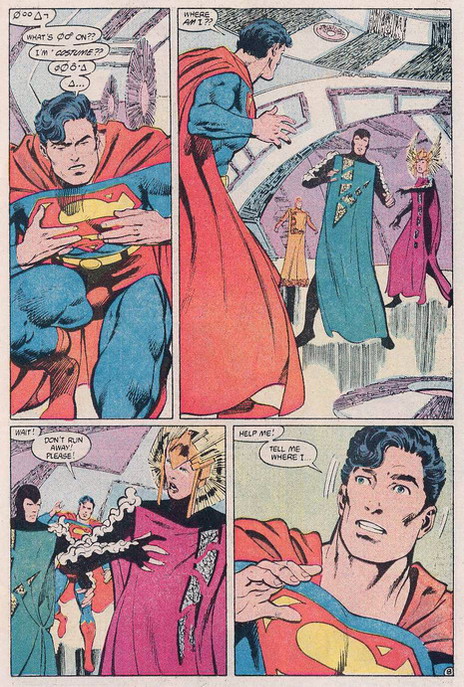
* I'm watching the old Superman movies again at home (I didn't realize that I was doing it in preparation for the new movie due out soon, but I am!). My wife noted how excited she gets, watching them. Me too. I remember how cool they were when I was a boy -- and, be damned!, they're still cool. The new movie has a lot of work to do if it's going to compare. Superman 1 really set the Kryptonian aesthetics perfectly -- the complex, jagged, crystalline structure of everything (that would later get folded into a robust, knotty, almost-tangled look under John Byrne's pencils in the comics) ...there was a kind of "smart stuff" or early "everyware" aspect to the way [Kryptonian] things looked in both the movie and with Byrne's take. It highlights their technological acheivements, and that heightens the tragedy of their doom. Awesome.


* Back to games for a minute. Comics and games seem to go together, somehow. What is it about them? In gaming you can become like the characters you read about in comics (of any genre). Games are a way to "do something" about unsolvable problems, too, in a way. More important than that, in my mind, is the transformative and "magickal" power of gaming -- to look squarely at a usually-hidden aspect of yourself in the context of a cooperative fictional environment and make that "self" do whatever you Will within the bounds of the agreed upon rules. I don't think magick is a big or important part of gaming culture, however... and maybe it's more effective as magick if the magick remains mostly hidden. Anyway.

* Games aren't gender-divvied, are they? Seems like I see throngs of both girls and boys playing the Yu Gi Oh or the Pokemon in the bookstores on the weekends. And everybody loves Scrabble and Monopoly and Poker, right? What about table-top RPGs? Still the domain of men? It's just interesting to me that games drew my wife back to a comic shop she swore off of. Looking for a game -- a cool game, not just Connect Four or something, but an unusual, under-the-radar, bottom-shelf, small press, game. She was looking for something obscure, see, and the best place to browse for off-beat games? You know. The comics shop. Now how does this play in the the bigger conversation about comics shops? Will games be (or are they already, or have they already been) a factor in getting more women into comics shops? And if they come seeking games, why not just go to a "game shop"? Comics and games seem to go together, somehow.

* For librarians... I again must stress the importance of collecting and promoting this stuff. Gaming books and graphic novels are hot, hot, hot, and it's not a passing fad. This has had and will continue to have staying-power. Design your programs (for any age groups) around these materials and watch a loyal community grow up around you. Go read PopGoesTheLibrary -- they know what's up. And, by the way, this isn't any kind of acquiescence to "low brow" media. Comics are full of advanced vocabulary and complex plots. Comics and games are good for kids (and grownups). You know that, don't you?

--

Weather: Finally cloudy.
Shushing: My insurance company.

obit: Ian Copeland of IRS Records

Here's an obituary for Ian Copeland from Surviving The Golden Age:

"Today is a sad day for many in the London and Georgia music scene. IRS co-founder and Georgian concert promoter, Ian Copeland has passed away from Melanoma at the age of 57. Ian is accredited with launching the careers of bands such as the Police, R.E.M., the B-52s, and Squeeze.


Ian's brother Miles Copeland founded IRS records and enlisted Ian to bring Squeeze to the states. Ian made Squeeze a hit in the states by booking them a long tour schedule of smaller night clubs. Ian later brought his younger brother's band, The Police to the states. Ian created what is now referred to as the "club circuit".

Later Ian started Frontier Booking International (F.B.I.) which booked for bands like R.E.M., The Bangles, Adam Ant, Nine Inch Nails, and the Dead Kennedys..."

*

At the post, there's a live R.E.M. set from 1982 in .mp3 files.

--

Listening: 1,000,000

Tuesday, May 23, 2006

info viz 4

A couple of info viz notes:

See a map of Amazon's books:


Weird. Fun.

--

Text represented as "binary signs" for the spaces you move around in:


This one puts me in mind of Semacode again, and makes me wonder about the possibilites of using ambient machine-readable markers in our spaces to link our machines with information. Kind of like a "magic eye" for computers that whisks the patron away to rich info resources.

--

Both found via http://infosthetics.com.

mls, mlis, certification

|UPDATE, Sep 07|

My thinking on this continues to evolve. What I wrote below was in part motivated by long years of observing dedicated library employees with very professional attitudes and great knowledge of sources and technique being treated sub-professionally. But the degree itself needs to be worth something and it should mean something -- it should be a qualifier without disqualifying those who work hard without it.

---

The graduate "library science" or "information and library science" degree is a funny thing. I worked in libraries for almost 10 years before I got the MLIS, and I think my experience taught me far more about how libraries should operate than the degree did.

The degree is a kind of initiation into "professionalism", and for all the great instruction (and independent research and practicums -- and I mean in no way to deny the value of what gets taught), the culture of the title "librarian" seems often to be more important than the practice to too many of my peers, these days.

The degree, too, is a period of intense thinking about and writing about libraries -- and that was utterly useful to me. It changed my life. But it's not the only way to go.

See, I hate this word "paraprofessional". It's demeaning. It means something to the effect of "on the side of" or "with" in the old Greek. The non-degreed librarians that I know (and have known) daily take the lead on matters of policy and customer service, and in the operational smoothness of our libraries -- while the "professionals" are in the background shaking hands with deans or city council members, brainstorming on programs, ordering books and doing other (very essential but usually less immediate) work. In reality, it's librarians who are alongside them, and not the other way round.

I think there should be a certification program for librarians, to grant "librarianship" after a period of practical experience, a few short (short!) courses, and test of some kind. A full-on "postgraduate degree" isn't necessary, especially when you consider the fact that this really is a sort of professional (as in more-professional-than-academic, as in more focused on the career or the profession of librarianship than it is on advancing the general body of knowledge related to information science... c'mon) and beuracratic hurtle. The degree is in most cases just a gate guard for administrators.

Librarians and libraries shouldn't be about that. 15 years of practical know-how should be worth far more than 4 semesters of online classes, a couple of field trips, and a piece of parchment. "Librarianship" shouldn't be so zealously guarded by the bean-counters when there are so many bright and able people who deserve advancement and would be considerable boons to our libraries. Some kind of certification program would solve these problems and get more people in the gate.

This "librarian" thing isn't a Sunday garden club, you know. Let's look at our assets -- at our dedicated "paraprofessionals", and let's train them up and certify them and put them where so many of them belong -- in leadership roles. Librarians could stand a bit of a de-high-horsing, and "paraprofessionals" could really stand to be looked at anew for what they are: professional.

--

Watching: Emmanuel's Gift
Listening: Squarepusher: Big Loada
Surfing: UFO crash: Aurora, TX, 1897

Monday, May 22, 2006

Via Lisnews.org:
"The Australian Federal Government may ban the sale of "hate books" and outlaw the glorification of terrorism. Islamic books that support violent jihad can be sold because sedition and incitement laws do not specifically ban them, according to legal advice to the Australian Federal Police.

Well this does go some way toward the concerns expressed in an earlier post. And this post (link), which deals with banned books in the U.K.

I really feel that this is coming our way, folks... It won't be long before the U.S. follows suit and starts outlawing books. Or, to be more accurate, outlaws the manifestation of ideas that are deemed dangerous to the state, whether in book form or whether spoken aloud in lectures.

Wednesday, May 17, 2006

da vinci code debate

I haven't read The DaVinci Code yet... I might get around to it some day, but I'm more interested (and have been for years) in what Stephen Hoeller has to say about church origins than I am in what Dan Brown says about it. I don't mean to knock Mr. Brown -- I haven't read any of his novels. But if we're arguing about doctrine and history, let's go to the historians and theologians, no? Instead of the novelists? It's like, you know, entertainment and education aren't exactly the same thing.

There's a metaphor now loose, though, and what ever mean-eyed arguments may continue erupting around the novel (and now the movie), it will be very dangerous to lots of Christian faithful -- the metaphor is something like "Christ is in us & he always was". Something like that.

Will believers go to their libraries and look deeper than the pro and con shout-down-books? Will they read the Nag Hammadi scriptures, and decide for themselves? Our patrons are better off (that is: better enabled to dig deeper and empower their own arguments for or against the "code") if we dig a little deeper too... Pull out the Margaret Starbird alongside The DaVinci Deception... Put out the Bethany House stuff alongside the Disinformation guides...

For my part, the fact that so many people have called for the movie to be censored pretty much guarantees that I'll go watch it. Are they trying to get me to see it? I don't cotton well to being told what information I shouldn't have access to... and if I like the movie, I might just read the book after all.

--

Watching: Ask A Ninja: "Net Neutrality"

Tuesday, May 16, 2006

image problem?

LISNews.org reports on a couple of famous authors (Rowling, Rushdie) getting out to support public libraries. It seems that libraries in the U.K. have an image problem?

In the Guardian Unlimited article that the story's drawn from, Alain de Botton is quoted: "It's in walking into a library that most people first get the sense of how little they know... Surrounded by so many books, we are liable to feel how great our ignorance is, next to all the accumulated wisdom and insight of others."

Huh. Don't quite know how to respond to that... except to say that I hope that's not the cause of Britons' avoidance of libraries. I don't agree with it -- I lived in England, and I never got the impression that folks were scared of their books, or intimidated by the insights of others. If that is the problem, they've got bigger worries than dwindling library circulation. Anybody know more about this issue?

"ideological exclusion"

Via The Kept-Up Academic Librarian:

"Since passage of the USA Patriot Act after Sept. 11, 2001, a number of academics have been denied visas or had them revoked. Universities and scholarly associations have written letters to the government to no avail."

So foreign scholars are being kept out of the U.S. seemingly because some in the government are worried about what they might say (link to Christian Science Monitor story) to us Americans. The DHS claims that these academics are kept out because the Patriot Act's section 411 gives the government the power to exclude anyone who espouses or endorses terrorism.

How long before we librarians are given a list of illegal books -- books that are said to espouse or endorse the viewpoints of terrorists? And since the t-word has such a broad definition, I reckon we'll all have lots and lots of weeding to do.

See also: Patriot Act in the U.K.

meta / universal library

In a previous post, I went daydreaming about a sort of universal library. Kevin Kelly's "Scan This Book!" just over at New York Times Magazine is a good overview of the dream of a "universal library", a library collecting all information in all media (across all time). Of course such a thing is impossible, despite the apparent optimism in Kelly's article -- and I think he makes the complexities of implementation abundantly clear. See also The Gypsy Librarian for more good questions about this subject. Angel is right to point out the obvious hitch in these bold dreams: not many of us, on balance, have computers.

I don't think it's possible to detangle the politics from the question of universal access. Kelly doesn't get into it, but there is a reason (besides the obvious technical and litigious barriers) that such a universal library doesn't exist. There's a reason that such a library will probably never exist. Simply put, it's not in the interest of the powerful to allow universal access to the world's information.

Not until the nature of "power" and leadership is radically altered will true empowerment for all people be seen as a good by the world's governors. It would take a true democracy, at least (if not an even more radically distributive and open system), in which "all" the people who have an interest in access are able to legislate and execute such access for themselves -- in other words, a system where every person actually has meaningful self-governing powers.

We're lucky that we can even have such conversations about the possibilities of universal access -- most aren't so lucky. And Google as the great enabler? Google censors searches in China to keep cozy with those in power. As long as it makes better political/business sense to keep people and information apart, this "universal library" won't be possible.

Who benefits from a universal library? Who takes a hit when we get the information to the people with impunity, or when people get the information to themselves? File "universal libraries" under post-Singularity daydreaming.

But that doesn't mean we have to give up.

--

Watching: Harold Bloom on BookTV
Feeling: churlish as hell
Surfing: swish-e.org

Sunday, May 14, 2006

homework, librarians

Basic information literacy skills: for any book, website, lecture, film, e-mail, or conversation, you've got to be able to determine if it's accurate, authoratative authoritative, current, objective, and what the scope of it is. At least that's what we like to teach our patrons around here: think critically about your sources.

Here's a spot of homework, then... does the following video (embedded from Google Video -- 9/11 Loose Change - 2nd Edition) meet these criteria?

Thursday, May 11, 2006

the singularity summit at stanford

If you're in the neighborhood on May 13th (that's this Saturday!), check out the Singularity Summit at Stanford. What's the singularity? "In futures studies, the singularity represents an "event horizon" in the predictability of human technological development past which present models of the future cease to give reliable or accurate answers, following the creation of strong AI or the enhancement of human intelligence. Many futurists predict that after the singularity, humans as they exist presently won't be the driving force in scientific and technological progress, eclipsed cognitively by posthumans, AI, or both, with all models of change based on past trends in human behavior becoming obsolete," say they.

I'd go if I could. Click image below to read about the speakers.

Wednesday, May 10, 2006

thinglink: more toward spimes

You've heard of Thinglink? It's one clever way to help realize that "ultimate geek dream of knowing where all your stuff is", to paraphrase Bruce Sterling quoting Warren Ellis. And it looks like a lot of fun. It taps the Make crowd, and they're a fun lot, for sure.

Does this stuff mean that all librarians are to become archivists of a kind? And are all physical objects (realia, in the parlance of catalogers) to become informational? Metadata for every pen and shoe and coffee cup and knitted pillow case on the planet? Or can we just skip the prentense and let librarians go the way of last-century's secretaries? (I don't think so.) More on this later.

Here's the video of Ulla-Maaria Mutanen talking about Thinglink, how it works, and a little about what it may mean. ...Every book/thing its reader. (And let's have a round of applause for ANT, while we're at it... it's high time it got a little more play.)


--

Feeling: very, very distracted

Monday, May 08, 2006

info viz 3

via Sukhdev's World, we find the InfoVis Wiki:

"The InfoVis:Wiki project is intended to provide a community platform and forum integrating recent developments and news on all areas and aspects of Information Visualization.

Using editable–by–anyone Wiki technology turned out to be the only way of keeping the presented information up to date and knowledge exchange vivid."

--

Listening: Alan Moore (et al) The Highbury Working
Next is: Angel Passage

comics 4

I made the mistake of taking my wife to a comics shop. I should have known better.

It was "Free Comic Book Day" this last Saturday, and I went in the afternoon to surf around for a new book, and, you know, support the medium. I found Shaolin Cowboy by Geof Darrow, and was mighty pleased. I also noticed some little wind-up robots (Kikkerland gadgetry!) on the way out, and they got to bugging me to the point that I decided to go back and buy one on the way to get groceries with my lady.

She hates comics. I've suggested Blankets, Ghost World, Orbiter, A Distant Soil, others, but she just can't get into them. Part of it, she admits, is a prejudice toward the key memes of the medium -- the capes and tights and muscles-for-justice. Part of it is that she thinks women are overly sexualized in comics... We debate this point (including the traditional oversexing of men in comics) about once a month or so. The sad thing is, she mostly right, because most comics still insistently truck in such dreck (so the brilliant stories get obfuscated by what's marketed to 13-year-old-30-year-olds).

So we go into the comics shop and I pick up my robot (okay, yes, my toy), and we're waiting quietly in line to buy the thing when the manager dons a black and purple belled jester's cap and addresses her, like, "Heeey! This is free comics day!! You can't have your hands in your pockets in a comic shop! Don't you wantafreecomic??!!" and starts jangling his cap, like he's talking to a 4 year old. All the folks turn to look at my wife.

She holds her own, says "No thanks. I don't even like comics." But the guy keeps blathering on and on. I butt-in and cut him off, saying that I've already got too many comics, yada yada, that I've already been in once today, yada yada, and that deflects attention from her. Cool.

Then when I actually check out, the cashier makes some kind of allusion/joke-thing about "Stargate: SG-1" and I don't follow the show, and my wife doesn't follow the show (we don't get channels, even, we just rent DVDs), so we're lost, but he's cracking up. Here's the money, thanks, bye, you've managed to out-nerd me. Congrats.

We step out to the sidewalk and she immediately says "I'm never going in there again."

Alright. Pause. Take a breath.

Librarians, notice!

This is the part where you think: "Gee. Most of the patrons who check out graphic novels from my library are teenage girls. Granted, they're almost exclusively taking out the manga love stories and teeny romance tales, maybe with just a dash of The Sandman or somesuch sometimes... But he's right. Comics shops are usually male-only domains. Why don't girls feel comfortable in comics shops, but very comfortable getting comics from my library?"

And this is the part where comic shop managers should take notice.

Most new readers are female, and most are young. That means that if you get your act together, wipe your noses, and make your stores inviting to the young woman demographic, you might just garner yourselves some lifelong customers. And you might just be doing your part to rescue the medium from itself.

Others have been writing about this for some time (see Warren Ellis' Come in Alone for a very good example), but I'm yet to see much change. Comics are absolutely going to suffocate in their own excrement of control fantasies and sexual fetishism unless alternative kinds of stories, styles, values, and aesthetics come to be celebrated, and come to be the touchstone in what we mean when we say "comics" -- and this needs to happen soon.

Now what can comic shops learn from librarians about cultivating a strong comics customer base?

  • Libraries aren't dingy, musty, dusty, and dark.
  • Libraries don't encourage groups of grown men to hang around cuss the %@#$ out of each other over the subtler points of orcish armor in D&D 3rd ed.
  • Libraries offer lots of kinds of stories in lots of formats -- not just superheros and hentai.
  • (and here's the main point) Libraries aren't creepy -- they're not the kinds of places where everyone leers when a girl (OH MY GOD, A girl...) walks in.

Obviously, not all comic shops are so bad. And superhero stories can be fun, for sure. I don't mean to throw it all out.

But a little sunlight and and a little cool music and a little bit of Bubble Tea culture would go a long way towards encouraging girls and women to pay a visit to the shop. A little less uber-nerdlingness and a little more of a "your you're cool, we're not creepy, please enjoy your visit" attitude in the shops would go a long, long way too.

It would have made all the difference to my wife on this last Saturday.

--

Listening: Paulo Conte

Friday, May 05, 2006

info viz 2

From NASA -- A .mov of the Cassini-Huygens Orbiter's Titan Descent Probe drifting down to land on the surface, with an accompanying wondermous little MIDI song...

Click on pic to view:


Now that's info viz done right.

they're made out of meat

If you've got 7 minutes or so, here's a weird, funny, short film adaptation of Hugo and Nebula Award winning author Terry Bisson's short story "They're Made out of Meat":

Thursday, May 04, 2006

libraries save worlds

I'm not a banker or a farmer; I'm a librarian. I don't know how to distribute micro-loans in Chad, or tinker with a heartier species of millet. I know books. Can libraries really save worlds? I want to believe it.

What can libraries do?

. Get the information to the people -- broadly and universally.

. Fend off censors -- be they religious or political.

. Support literacy -- for all ages, across any medium.

. Preserve cultural history -- we're the information bank, and we are long-term memory.

. Spur trust -- mix readers with programs and events.

If we can do that in every country, we can make headway in defeating evil in this world. Evil? I'm a pragmatist. Whatever the root causes may be, evil occurs. Libraries represent a universal ethos of liberalism, pluralism, discovery, and the conservation of knowledge. Libraries work for good, or they should.

The long term plan? Sustainability? 10,000 years ahead? We're part of that. You do it every day.

I keep coming back to the question, despite or because of the hunger and the war and the rape: how do we put a library in every village in Africa?

And I must be embarrassingly naive. I've e-mailed librarians in Sudan and Egypt and elsewhere, asking questions, seeking contact. They don't write back. They're busy with bigger problems. Libraries in every village? How about clearing the flies out of our children's eyes first.

Jesus.

This is going to take legwork.

Wednesday, May 03, 2006

info viz 1

Check Information Aesthetics for many nifty tools that let you see data turned into pictures. It led me to my new favorite toy: Globe-i from Infomagnet. Globe-i lets you turn economic data into 3-d charts on a spinning model of the Earth, like this (a viz of the % of imports from Indonesia by country):


Info Aesthetics is constantly linking to very interesting (and sometimes quite useful) vizualization tools -- like this "Sector Snapshot" Utility from the New York Times business section.

--

Playing: LEGO-StarWars, fool!

an inconvenient truth

I'm from Mississippi. I love Mississippi. Mississippi is a slightly coastal state (kind of north-west of Cuba). I've got family still living in FEMA trailers (and this is 3 May 2006).

Which is a preferatory note to say that I'm perpetually interested in what the big-hairdos in our halls of power have to say about "global warming". So I'm going to see Mr. Gore's take on the subject by way of his movie An Inconvienient Truth (FYI, here's a link), in hopes it indicates a shift of priorities in re: global warming amongst the hairdo crowd, and out of curiousity.

--

A few "global warming" resources I've found to be of use:

For Kids:
http://www.epa.gov/globalwarming/kids/
http://www.exploratorium.edu/climate/index.html

Climate change items from NOAA:
and http://www.noaanews.noaa.gov/stories2006/s2622.htm
and http://lwf.ncdc.noaa.gov/oa/climate/severeweather/extremes.html
and http://lwf.ncdc.noaa.gov/oa/climate/globalwarming.html

Kyoto Protocol:
http://unfccc.int/essential_background/kyoto_protocol/items/2830.php
http://unfccc.int/methods_and_science/items/2722.php

Documenting change:
http://www.glims.org/MapsAndDocs/

Union of Concerned Scientists:
http://www.ucsusa.org/global_warming/solutions/
http://www.ucsusa.org/global_warming/science/global-warming-faq.html

--

I like my books dry.

libSOS

I've started a sister blog to this one. It's called libSOS (for "library SOS"), and it's all about "Hacks for Librarians. Shortcuts, freebies, sharables, good ideas, quick tips, tricks, suggestions, and hopeful notions for underfunded d.i.y. librarians who live somewhere on Earth and need to get the information to the people."

The idea is to make info available for tinkering, modding, tricking-out, re-vamping, and skin-of-teething for librarians who lack the funds or support they need to get the information to the people. The aim is to share ideas that let us get the information to the people despite the challenges we face.

I hope that posts will range from the very specialized (skirting Sharia law to distribute books in Khartoum) to the universal (repairing a torn page with home-made paste).

I haven't seen anything like this elsewhere, but if I've missed it give me a shout -- and feel free to, too, if you have suggestions or want to share a tip.

The blog is http://libsos.blogspot.com

--

Shushing: book burners

me in 2nd Life

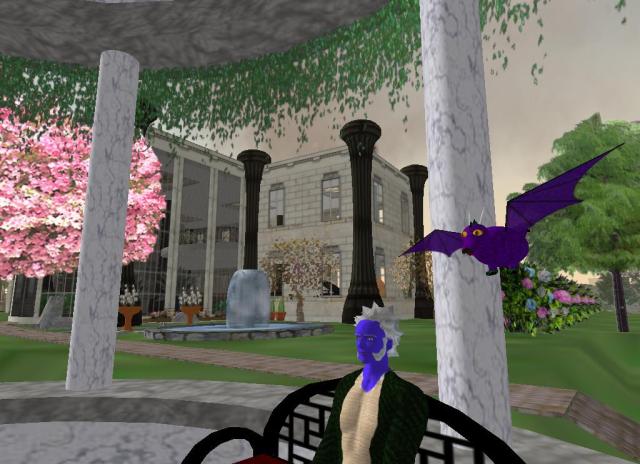
Yes, I signed up... Baffled by it all and rather late (but present, finally) I'm in Second Life now. Here's a postcard of me enjoying a little quality time with a dragon, just outside the new library (secondlife://Minoa/200/85/112):


Mostly I'm just flying around, chatting with librarians, and trying to figure out what this really is all about. I'm also thinking about other usese for it... I'm a real newbie. Can I learn Mandarin in there? Could the laptops of OLpC support Second Life or something like it?

Can I learn skills like carpentry or soapmaking or sewing or lens calibration in-world? Are we free to share what we know, and share outside resources, Creative Commons style? What, exactly, belongs to Linden Labs (especially in terms of content)?

I've got lots to learn, if this fascination holds out.

Check in with the librarians if you are in-world. They, as you might expect, are a mighty helpful and generally awesome and excitable bunch.

--

Reading: Accelerando by Charles Stross
Listening: Billy Bragg -- Back to Basics

Monday, May 01, 2006

interview: Sven Johnson: Designing Information

Following is an interview with Sven Johnson, a visionary designer and old-fashioned problem-solver of the first order. Sven writes at reBang weblog, and some of his work can be seen at the online gallery coroflot.com.

--

W> Hi Sven, and welcome. What sort of projects are you working on at the moment?

S> Howdy. Thanks.

Like many industrial designers I have plenty of projects at various stages of development, so this is a harder question to answer than it normally should be. That said, much of my time for the past few weeks or so has been spent working with another individual on something I can't discuss. Sorry. There's no time line, but I'm hoping we can announce it (assuming we don't crash and burn) within the year.

Unrelated to that effort, as of last week I finished contract negotiations with a recently-formed company and expect to start a project I also can't discuss (it was support to start today, actually). However, I can say that the project came to me not because of my industrial design background, but because of my blogging about related issues. It's a good fit in that there are no conflicts of interest with the previous project and no conflict with my regular design consulting - which is ongoing. It has, however, necessitated that I devote some time gearing up for it.

The third thing that's been on my "To Do" list (and which I recently discussed at length on my blog) is my "protoSat" project. This is a 3D construct inside the Second Life virtual space primarily intended to be a kind of nexus between the real and the virtual where mostly real world-related activity takes place. By that I mean it would function as a place for lectures and discussions, design critiques of real world projects, and so on. A big part of the challenge is figuring out how to make it a profitable or break-even venture, but do so in an open source environment where people don't have to pay for access to the knowledge and by using ad revenue from small, independent companies instead of large corporations. I'm big on helping to democratize online spaces so that's something I'm trying to piece together.

Another project that I've recently started getting back to again is an ecoToroid animation. I'd exchanged emails with Chris Anderson (Senior Editor of Wired online) a few months back after I'd commented on his blog that some of his time-dependent curves seemed to be supporting my ecoToroid concept (The Long Tail curve in 3D about which I'd been previously interviewed). He wasn't understanding the static images I'd rendered and when I suggested an animation might help, he expressed an interest in seeing one. I'd like to get back to that and put it to rest.

In addition I have a couple of kirkyan ideas I'd like to develop. You read the oil spill containment device example on the Wikipedia entry, so there's that idea. I doubt I'll get to the second, a robotic termite building system, but the oil containment concept is something that I could do in short order; similar to how the RadTag was completed.

I've also recently contacted a few people for other projects. One is an indy filmmaker that hangs out on the b-independent website film forum and who is trying to distribute her work. The other is what I call the "PreFab Crab" project by Elizabeth Demaray and which I read about recently on the Inhabitat blog. I've conversed with the filmmaker who is interested, but I've not heard back from Ms. Demaray, which is a shame since I'd like to set up a design competition (similar to what I put together over on the Core77 website) and let a bunch of IDers come up with some ideas. If that doesn't happen, I'll design a few for fun.

There are more things (like some old PDA-watch concept sketches I'd like to CAD up and render, and getting back to reverse-engineering a high resolution model using the OGLE 3D capture tool, the low rez capture and the normalmap), but these are the one's that occupy my mind right now.

-

W> We've been talking about "kirkyans", lots lately. What inspired you to coin this word and develop the concept?

S> The concept itself is just the stuff I think about on a daily basis. For a very long time I've not distinguished between "real" and "virtual". That's why I've done some of the things I've done (e.g. ripping 3D data from a videostream and converting it to manufacturable data). As for coining the term, to be honest, I was inspired to give the concept a name because I and others have had other ideas which were given names well after the fact. It bothers me that coining a term bestows automatic authority and qualification when there may, in fact, be none. As I've stated elsewhere, it reminds me of what's worst about our patent system where obvious ideas can be claimed. I don't pretend to be at the level of many intelligent people who discuss and debate these things, and so I claim no authority or qualification or ownership to the idea. Instead I assume someone else has had the idea and am merely helping to put it into the public domain for further discussion and, hopefully, development.

-

W> How much weight does the word "spime" have in the design world in 2006?

S> Basically none. Both Adam Greenfield (author of the new book "Everyware") and I are mystified by the general lack of interest among industrial designers.

-

W> As you know, I think the concept of the kirkyan may be very useful for libraries. But what I've tried to write about it has so far been abstract -- just pie in the sky. Can you suggest any specific, real-world kirkyan applications for libraries?

S> Well, off the top of my head I think e-books that allow every individual to add comments and notes which can then be tagged, searched, and interactively overlaid might be interesting. Imagine if that book had a physical Master and multiple virtual instantiations available to people everywhere through an immersive 3D space (like how Second Life now has virtual books) or through other platforms that allowed them to add their own notes, have them both automatically aggregate and self-distribute and then perpetuate and perhaps even evolve with the original language. It's almost like peer-to-peer knowledge sharing or something. I don't know what you call that. But it's the opposite of one lone researcher sitting in a library and scribbling notes in the borders of a book that will be seen by few, if any, people. And if those scribbles are brilliant insights then the hope, of course, is that the world has access to that thinking. Not when someone discovers it, but in realtime.

-

W> Why does design matter, and how do you personally define it?

S> Tough questions. I don't regard myself as a hardcore designer, to be honest. I would feel uncomfortable among the "name" designers. I will confess that I don't believe I give it as much thought as many other designers and actually, to be honest, I don't think about what others think about design too often. I've not even really seriously considered these questions before; entries on the Core77 forum are about as much as I've done.

If pressed I'd define design in it's broadest terms. It's not form. It's not just function. It's putting order to disorder maybe. In that way, everyone is a designer. We arrange our home; our CD collections. We determine which clothes fit our idea of who we are and how we want to communicate that sense of self to the world around us. We decide whether or not to separate our vegetables. Or not. We control our worlds. So in that sense, design is about us in relation to everything, and in that way it matters to each of us and thus achieves a level of importance on both an individual and social level.

That might sound deep, but it's really just my way of not being pinned down. Maybe that is, in itself, the best answer.

-

W> Your RadTag seems more like an "invention" to me than a "design" (and, oddly, it's sort of like a little smart e-pamphlet for radiation damage) -- is there a difference between the two these days?

S> I don't honestly know what an invention is anymore. To be honest, I blame that on a broken intellectual property system even though that's arguably a cop-out. I did consider the RadTag as something potentially patentable, but the truth is the system is not conducive to an individual like me getting the kind of protection afforded to corporations. It's expensive. And assuming I were even awarded a patent, I might then face a corporation intent on simply stealing the idea and forcing me to defend my patent in court. Even if I had a case and lawyers who'd represent me for a percentage, I'm not interested in wasting time defending an idea. So whether it's a design or an invention, for all practical purposes it really makes no difference to me in the end.

-

W> Most librarians are still heavily invested in the concept of book-as-paper-ink-glue. We're a conservative bunch, by nature, and books have been a hearty medium since before Gutenberg and Caxton and them. As a designer with an eye for shifts in information technology, do you think that the traditional book-object will continue to be viable for the next 500 years?

S> Maybe not in the way it is now, but I think it might have a small community that supports the format and the functionality it provides. There are a number of mediums that have had their obituaries prematurely written. There will be paper books imo.

-

W> Who's your favorite architect? Designer? Why?

S> I don't play favorites. My favorite architect is the person who designed the home in which I live and provides me shelter. My favorite designer is the person who designed the product I decided to purchase and which makes a mundane task I have to do a little easier.

I think we need fewer superstars and more recognition of the people who do the job day-to-day just like we need more recognition for the people who teach our children and those who do the jobs no one else wants to do. I don't have anything against those who garner accolades and some measure of fame. It's just that I see a greater need to celebrate those working in the trenches.

-

W> What can designers and librarians do together to make the world a better place?

S> Learn and Teach and help others to do the same.

-

W> Last one: What kind of projects are you working on for the rest of the summer?

S> I have so many projects I'd like to do but have so little time. Like most people I'd like to write a book. I have film equipment and would like to make a short film. I have an idea for a videogame and would like to program it. I was reading Emeka Okafor's website last week and struck by the opportunity to help fledgling companies in Africa to compete in the global economy. I'd like get back in touch with an organization in Bangladesh and offer whatever services I can provide (I lost touch after 9/11 and the plight of women in SE Asia is often on my mind). I'd like to get more involved in charities and fundraisers. I could go on and on. One simple thing I should add is that I'd like to get my homemade, unleavened bread recipe to come out consistently. Right now it's strictly hit or miss.

--

Thanks, Sven!

infinite games in your library

I was just listening to a lecture by James Carse over at the Long Now Foundation (link to audio here), and was really affected by a comment he made in summary of his notions on finite and infinite games.

He said: "A finite game is a game you play to win, and an infinite game is one you play to continue the play or to keep the play going. An infinite player has the talent of seeing when someone is about to lose and is able, when he or she does see that, either to change the rules or find some other way of getting that person back into play. ... an infinite game... has the freedom to change the sturcture structure of the game to keep everyone in play."

Librarians have to learn how to become infinite players. We have to learn how to keep people and information in the same game. Maybe that game is the game of learning, which begs a question about our basic aims and assumptions (if libraries can save the world, does that mean knowledge and learning alone lead to the betterment of mankind? As 19th Century as it may sound, I think I have to admit that I'm still prejudiced toward the essential goodness of knowing. Wow. Where was I during the World Wars?).

So keeping people in the game, and keeping "books" in the game is what we've got to do to keep the game going. We're very good at keeping books in the game -- some of the most radical librarians I know (radically inclusive) are catalogers.

Along the way, we're getting better and better at keeping people in the game too. All this Library 2.0 business really boils down to increasing access, in my mind, though much of the conversation is naturally tilted toward "Wow! Ain't these techno-toys cool?!". Web 2.0 comes down to making user-centered values more central to fetching and finding information online. For librarians that means making our services into more of a conversation and allowing greater user participation in the workings of the library -- letting users state their own needs more clearly, and allowing them to make their marks on our libraries more visibly.

We can't keep our patrons in the game if we don't work on the good old "high touch" values of listening, asking good questions, speaking clearly, showing and doing (rather than telling), and working hard to get the information to the people. We keep patrons in the game by explaining why we look at the index first. We keep them in by explaining the call number ranges. We keep them by going to their work stations and having them use the mouse and type, rather than having them squat by the reference desk as we breezily stroll through the correct steps to find articles.

This "game" of libraries is an infinite game, I think. There is no ultimate goal except to keep it going, maybe, because no one stops learning. So if our patrons drift away because they feel like they are losing, then it is absolutely imperative to change the rules of the game.

Check out Carse's book Finite and Infinite Games, too -- it's an oldie, but a goodie.


--

Listening: Neil Young
Shushing: those who shush others too often.